Analyzing Academic Bluesky with Skygent
What 48,000 paper-sharing posts reveal about how science spreads on Bluesky — the 6 AM bot spike, arXiv's dominance, and which papers went viral
In a previous post, I described how I recreated Paper Skygest — an academic paper recommendation feed for Bluesky — using Effect and Cloudflare Workers. I’ve had it running for a few weeks now and collected a decent chunk of data. This post looks at what’s in it.
I also built Skygent, a standalone CLI for pulling Bluesky data into local SQLite stores and running queries against them. I used it to grab engagement metrics for the analysis below:
skygent query papers --sort by-engagement --limit 100 --format json --fields "@social"The data
12 days of posts (January 21 – February 3, 2026). 48,434 posts sharing academic papers from 14,381 accounts, linking to arXiv, bioRxiv, Nature, PubMed, and others.
Where the papers come from
arXiv dominates — over half of all shared links. The top five sources cover 88% of posts.

Preprints (arXiv + bioRxiv + medRxiv) make up 61% of everything shared. High-profile journals like Nature and Science account for about 5%. Code repos (GitHub, HuggingFace) barely register.
The 6 AM spike
Every weekday, posting volume spikes at 06:00 UTC — 727 posts on average in that single hour. By 07:00 it drops to 90.

That’s when arXiv publishes new papers. 123 bot accounts, most tuned to a single arXiv category, pick them up immediately. They all fire at once, then go quiet.
Bots vs. humans
Of the accounts that interact around paper sharing, about 77% are human, 19% are bots, and the rest are aggregators or institutions. When you look at top-engaged posts, human-shared papers get way more interaction (median 22 vs. 5).

Worth noting: this only covers high-engagement posts, so it’s comparing the best of both groups, not typical output.
The interaction network has a hub-and-spoke shape — a few accounts broadcast to many passive followers. Science journalism outlets like science.org act as bridges, carrying papers from academic clusters to a wider audience.
Top papers
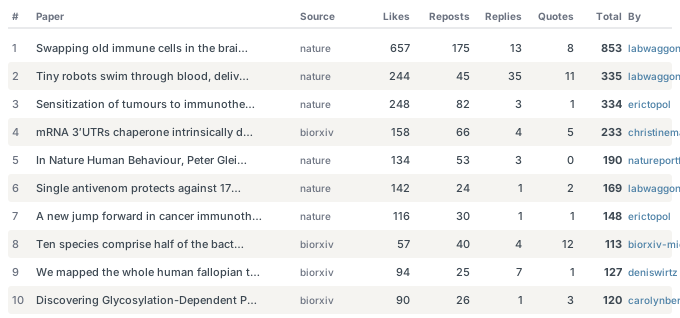
Here are the 10 most-engaged papers from the collection period. Health and medicine dominated — and one curator, @labwaggoner, shows up three times.

AI/ML keywords
About 5% of posts mention AI or ML terms (ai, neural, llm, deep learning, transformer, gpt). General science terms (health, climate, protein) appear in about 4%. Most of the rest is generic academic language.
Caveats
This is 12 days of data. The top-papers list is drawn from the highest-engagement posts — viral hits, not typical posting. Bot/human labels come from heuristic matching on account names and profiles.